 WeightLogicHub
Lipid Digestion and Transport
Understanding fat metabolism and utilization in the body
Dietary Lipid Structure
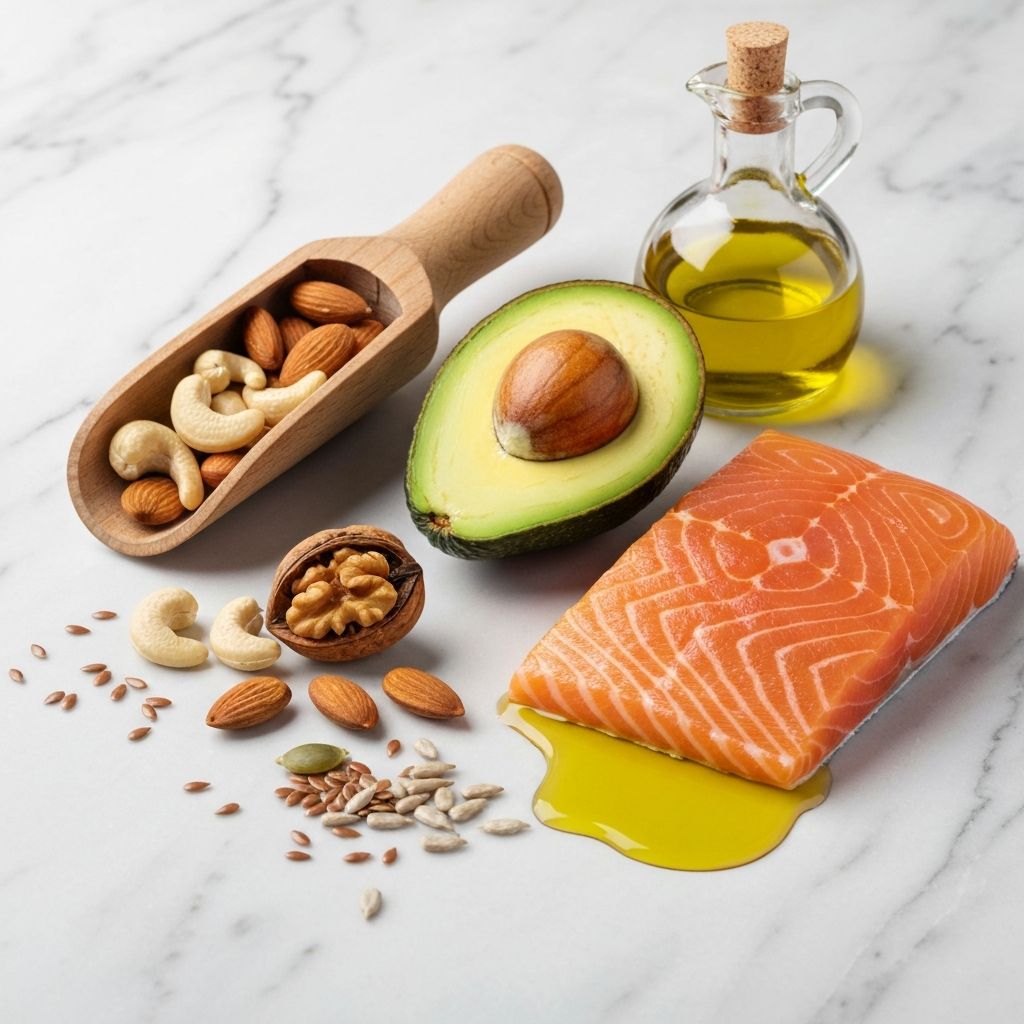
Dietary lipids primarily consist of triglycerides (triacylglycerols), which comprise three fatty acid molecules attached to a glycerol backbone. Fatty acids vary in chain length and degree of saturation. Saturated fatty acids have no double bonds and are typically solid at room temperature. Unsaturated fatty acids contain one or more double bonds; monounsaturated fatty acids have one double bond while polyunsaturated fatty acids have multiple double bonds. Different fatty acids have distinct chemical properties and metabolic effects.
Dietary lipids also include cholesterol, a sterol compound essential for cell membrane structure and hormone synthesis, and phospholipids, which form the lipid bilayer of cell membranes. Fat-soluble vitamins (A, D, E, K) are often consumed with dietary lipids.
Fat Digestion
Dietary fat digestion begins in the small intestine with the emulsification of fat droplets by bile salts produced by the liver and stored in the gallbladder. Bile salts break large fat droplets into smaller micelles, increasing surface area for enzyme action. Pancreatic lipase, the primary enzyme for fat digestion, breaks down triglycerides into monoglycerides and fatty acids. Other lipases including gastric lipase and phospholipase A₂ also contribute to fat digestion.
Fat Absorption
Monoglycerides and fatty acids are incorporated into micelles along with bile salts. This allows transport to the intestinal epithelium, where lipids are absorbed. Within intestinal cells, monoglycerides and fatty acids are re-esterified into triglycerides and combined with cholesterol, phospholipids, and proteins to form chylomicrons—large lipoprotein particles. Chylomicrons are secreted into the lymphatic system and eventually reach the bloodstream.
Lipoprotein Transport
Lipids in the bloodstream are transported in lipoprotein particles of varying density. Chylomicrons transport dietary lipids from the intestine to tissues. These are the largest and least dense lipoproteins. As they circulate, lipoprotein lipase in capillaries breaks down triglycerides in chylomicrons, releasing fatty acids for uptake by tissue. The remnants are taken up by the liver.
VLDL (very low-density lipoprotein) transports triglycerides synthesized in the liver to peripheral tissues. As triglycerides are removed, VLDL becomes progressively denser, eventually converting to IDL (intermediate-density lipoprotein) and then LDL (low-density lipoprotein), which transports cholesterol to tissues.
HDL (high-density lipoprotein) transports cholesterol from peripheral tissues back to the liver for excretion, a process called reverse cholesterol transport. HDL is the most dense lipoprotein.
Fatty Acid Utilization
Fatty acids taken up by tissues can be used immediately for energy or stored as triglycerides in adipose tissue. When needed, stored triglycerides are hydrolyzed by hormone-sensitive lipase, releasing free fatty acids into the bloodstream. These fatty acids are transported bound to albumin to tissues for oxidation.
Beta-Oxidation
Fatty acid oxidation (beta-oxidation) occurs primarily in mitochondria and involves sequential removal of two-carbon units from the fatty acid chain. Each cycle of beta-oxidation generates one acetyl-CoA unit and produces NADH and FADH₂. Acetyl-CoA enters the citric acid cycle for energy production. A 16-carbon fatty acid can generate approximately 129 ATP molecules through complete oxidation, making fat an energy-dense nutrient.
Ketone Body Production
When acetyl-CoA production from fatty acid oxidation exceeds the capacity of the citric acid cycle, excess acetyl-CoA is converted to ketone bodies in the liver. Ketone bodies (acetoacetate, beta-hydroxybutyrate, acetone) are utilized by brain, heart, and other tissues as alternative fuel sources. Ketone body production increases during prolonged fasting or very low carbohydrate intake.
Cholesterol Synthesis
The body synthesizes cholesterol from acetyl-CoA through a series of enzymatic reactions. While dietary cholesterol contributes to circulating cholesterol, the liver synthesizes approximately 800-1000 mg of cholesterol daily, making endogenous synthesis the primary source. Cholesterol is essential for cell membrane structure, hormone synthesis, and bile acid production.
Fat Storage
Excess dietary lipids and other energy substrates (carbohydrates and excess protein) can be converted to triglycerides and stored in adipose tissue. Fatty acid synthesis (lipogenesis) converts excess acetyl-CoA to fatty acids, which are then incorporated into triglycerides for storage. Adipose tissue represents the primary energy storage depot and has virtually unlimited storage capacity.
Educational Information
Educational content only. No promises of outcomes. This article explains the biochemistry of lipid metabolism and utilization. Information is provided for educational purposes and does not constitute personal health or dietary advice. Individual metabolic responses and lipid metabolism vary widely based on genetics, health status, and other factors.